AI Marketing for Small Businesses: A Strategy-First Guide (Not Another Tool)
Most of the AI marketing advice aimed at small businesses skips the only part that matters. It hands you a tool and tells you the tool is the strategy. It is not. AI marketing for a small business can absolutely work, but it works in one specific order: you decide where the business is going first, then you let AI help you get there faster. Run it the other way and you just buy a faster way to guess.
Free Field Guides
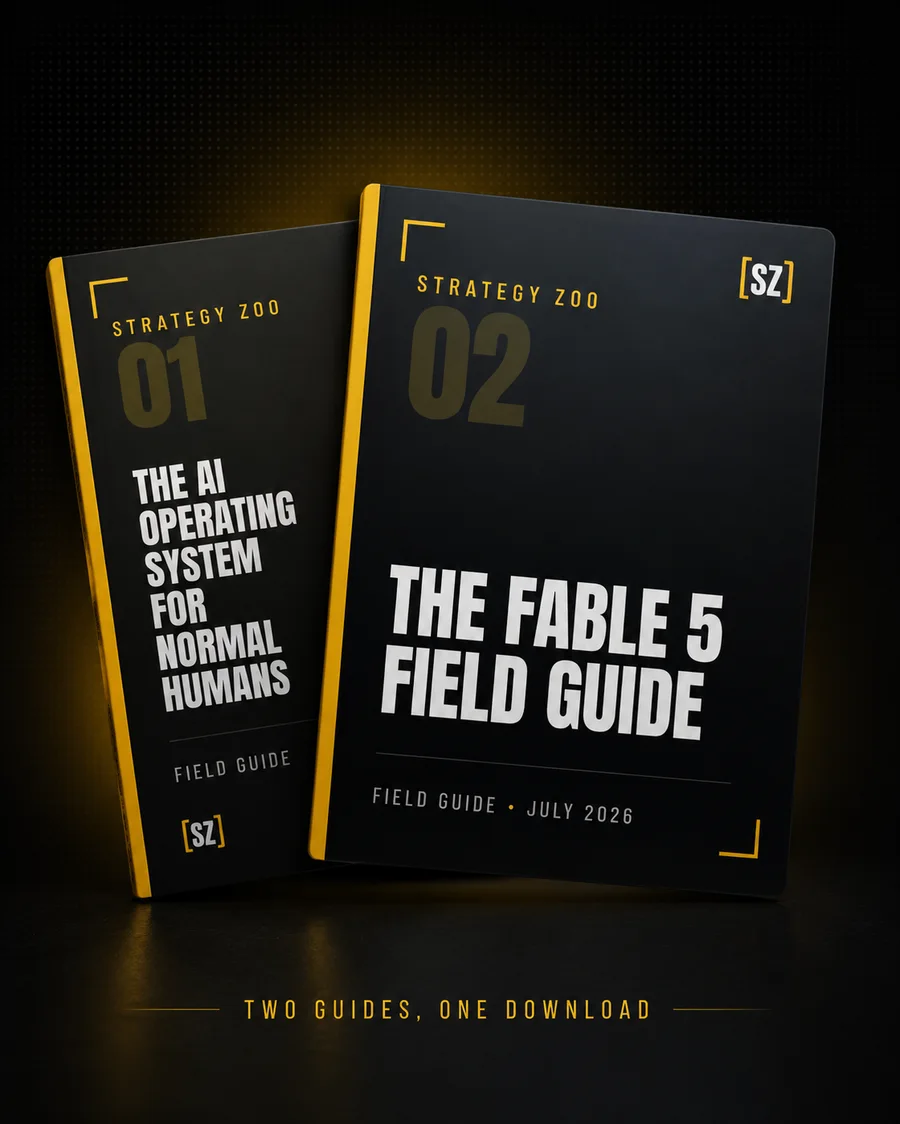
Two Field Guides That Make AI Actually Make Sense.
Everything on this page, in take-home form. One guide gives you the AI vocabulary in plain English. The other shows how I would put Fable 5 to work in a real business, starter prompts included. Both free, no code required.
Get Both Guides Free or browse all the free resourcesWhat AI Marketing Actually Is for a Small Business
The tools speed up the work. They do not decide the strategy.
You decide where the business is going. The offer, the audience, the message. Direction stays yours.
AI helps you get there faster. Drafts, follow-ups, scheduling, sorting. Speed, not steering.
Run it the other way and you buy a faster way to guess.
For a small business, AI marketing is not a robot that runs your company. It is a set of tools that do marketing work faster and cheaper than you could by hand. It can draft an email, build a follow-up sequence, write a first pass at a blog post, schedule your social posts, sort your leads, and answer common questions while you are busy doing the actual job. That is real, useful work, and the prices have come down enough that a one-person shop can use it now.
Here is the part the ads leave out. Every one of those tasks assumes a decision has already been made. The tool needs to know who you are talking to, what you are offering, and what you want them to do. It does not make those calls. It executes them. The businesses that win with AI are the ones that already knew the answers and used the tool to move faster.
The Trap: Buying a Tool Before You Have a Strategy
Software cannot stand in for a decision you never made.
The most common way I watch this go wrong is simple. An owner sees a pitch for a platform that promises a marketing team without the payroll, no experience needed. It sounds like a shortcut past the hard part. They sign up, point it at something vague like more leads, and let it start running. Three months later the dashboard is full of activity and the phone is not ringing any more than before.
That is not a tool failure. That is a tool faithfully executing a strategy that was never there. It pushed a fuzzy message to a broad list and did it fast, which means it reached the wrong people faster than the owner ever could alone. AI without strategy is just guessing faster, and the subscription bills whether the guess landed or not. The honest fix in that situation is almost never a better platform. It is a clearer answer to who the business is actually for and why they pick you over the shop down the road. If you cannot answer that, the question of whether you need a strategist or a tool is premature, because the strategy is the missing piece.
What Strategy-First AI Marketing Looks Like
Name the direction first. Then let the machine run it.
Strategy first does not mean a hundred-page plan before you touch software. It means you can say, in plain language, three things: who your best customer is, what you do for them that they actually want, and the one move that would grow the business this quarter. When you can say those without hedging, AI becomes genuinely powerful, because now it has a direction to execute against.
Picture an HVAC company in Chubbuck that knows its best jobs come from homeowner referrals, that its busy stretch starts in May, and that its spring tune-up offer is one people say yes to. Now automation earns its keep. It can text last spring’s customers in April, follow up with the ones who did not book, and tag the ones who did. The owner made every one of those decisions. The tool just made sure none of them slipped. That is the right order.
What to Automate and What Still Needs a Human
Automate the repeatable. Keep a human on the judgment.
Automate the repeatable
- Follow-ups sent on time
- Posting on a schedule
- First drafts of emails and posts
- Moving a lead to the next step
- Answering the same five questions
Keep a human on the judgment
- Deciding who you are for
- Naming the real bottleneck
- Choosing what to stop doing
A good rule: automate the repeatable, keep a human on the judgment. Sending the follow-up at the right time, posting on a schedule, drafting a first version, moving a lead to the next step, answering the same five questions every week. That is repeatable work, and AI is good at it. Hand it over and buy your time back.
The judgment is a different category. Deciding who you are for. Naming the real bottleneck. Choosing what to stop doing. Those determine whether the automated work is even pointed in the right direction, and they are exactly the part the tool cannot do. If you want to go deeper on automation, here is the piece on whether you should automate at all and when it just wastes money.
The AI Marketing Questions Owners Actually Ask
Straight answers to what comes up on every call.
A few come up on almost every call. Should I worry about showing up in ChatGPT and Google’s AI answers? Yes, and that is a real and growing channel, covered in how to show up when people ask AI who to hire. Can AI write my blog and emails? It can write a solid first draft fast, but it needs your direction and a human edit so it sounds like you. Will AI replace my marketing person? No. It replaces tasks, not judgment. Should I run AI-driven ads? Only after the offer and audience are clear, because paid traffic pointed at a weak message just loses money faster.
How Strategy Zoo Approaches AI Marketing
Strategy first, every time. Then the tools.
We are not anti-AI. We use it every day and set it up for clients. We just refuse to run it backward. We get the direction clear first, then we let AI and automation execute against it. The faceless platforms cannot sell you that, because the part they skip is the part that takes a person who has seen your kind of business before.
If you are weighing AI marketing for your small business and you are not sure whether you need a tool, a person, or just a sharper version of what you have, start by getting the direction clear first. That is what a Clarity Discovery Call is for. Thirty minutes, we find the actual bottleneck, and I tell you straight what the right next move is, even when it is not hiring us. You can also see what we actually do. The U.S. Small Business Administration makes the same point: define your market and your plan before you spend on running it.
Frequently Asked Questions
The questions I get most, answered straight.
What is AI marketing for a small business?
It is using AI tools to do marketing tasks faster and cheaper, things like drafting emails, scheduling posts, sorting leads, and writing first drafts. It speeds up execution. It does not decide your strategy for you, which is why it only pays off once you know who you serve and what you are offering.
Can AI really do my marketing for me?
It can do the tasks, not the thinking. AI will execute whatever direction you give it, fast. It will not tell you that your offer is aimed at the wrong customer. Treat it as a very capable assistant, not a replacement for the decisions that drive results.
Is AI marketing worth it for a small business in Idaho?
Yes, when there is a clear strategy underneath it. For a local service business, AI can handle follow-up, reviews, content drafts, and scheduling so you spend less time on marketing busywork. Pointed at a vague goal, it just spends your money faster. The strategy is what makes it worth it.
What should I automate first?
Start with the repeatable work you already know is worth doing: follow-up messages, review requests, appointment reminders, and social scheduling. Keep a human on anything that requires judgment about who you are for and what you say to them.
Do I need a marketing strategist if I have AI tools?
If you can already state your best customer and your next growth move in plain language, you may just need the tools. If you cannot, no tool fixes that. That gap is a strategy problem, and getting it solved once makes every tool you buy afterward work better.